Showing posts with label distracted driving. Show all posts

Monday, December 20, 2021

Two of the Most Dangerous Highways in America are in North Texas

We drive on highways every day, but some are more dangerous than others. Whether it’s because of a high speed limit, the volume of cars traveling it, or the condition of the road, some highways consistently have more crashes than others. Every year, over 30,000 people are killed in road crashes in the United States.

The number of deaths on the 100 most dangerous roads accounted for 10% of the fatalities in the entire country from 2015 to 2019. There were 109.6 fatalities for every 100 crashes on the country's 100 deadliest roads.

TEXAS HIGHWAYS

I-20 ranks at No. 2 and I-35 is at No. 5 based on data gathered from the National Highway Traffic Safety Administration and the State Department of Transportation.

Interstate 20 and Interstate 35 are among the top five deadliest roads in the U.S. according to the National Highway Traffic Safety Administration (NHTSA).

IH 20 As one of the shortest highways on the list, I-20 stretches from West Texas to South Carolina, going through North Texas; Jackson, Miss.; and Atlanta, Georgia. But it records the second-highest rate of fatalities per mile. In 2019, the NHTSA listed 13.52 fatalities per 100 miles on Interstate Highway 20.
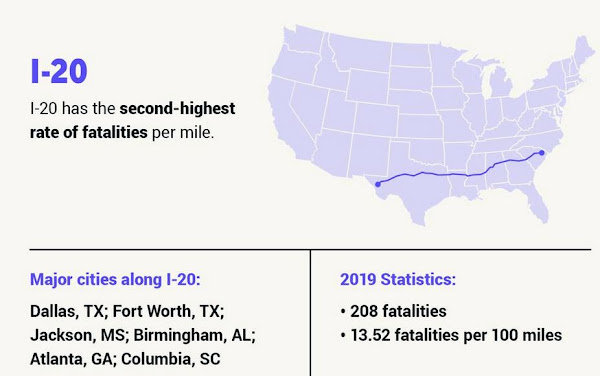
Interstate 20 Map
IH 35

I-35 stretches from Minnesota to South Texas, including Dallas-Fort Worth, Austin and San Antonio. Last February, icy conditions lead to a major accident on Interstate 35 West in Fort Worth, Texas. At least six people have died and at least 36 people were taken to area hospitals.
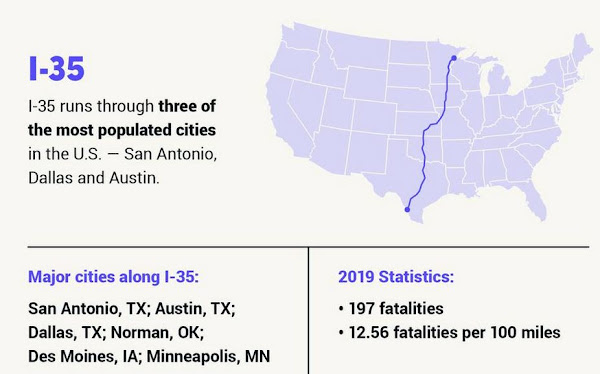
Interstate 35 Map

The State Department of Transportation recently unveiled a new campaign, #EndTheStreakTX,to reduce traffic deaths.

Being aware of dangerous roads is the first step in making them safer. Every driver plays an essential role in maintaining the safety of our highways, and learning to practice safe driving principles behind the wheel — every time — is each person’s responsibility.

While certain roads are labeled more dangerous than others, the fact is, about 90% of crashes are due to human error.

Holiday Travel

The holiday season marks the time of year when more people are behind the wheel and have more distractions than usual.

Winter holiday traffic is full of its own risks. Although the rate of crashes typically declines slightly on the actual day of the holiday, the days around that holiday see an uptick in crashes as more cars crowd the roads. Whether people are traveling to see family, on their way to the shopping mall, or out for a holiday party; you’ll share the road with more drivers, which means you have to watch out for more driving hazards.

Avoiding Holiday Driving Dangers

Drunk Drivers
While New Year’s Eve is often assumed to be the holiday with the most alcohol-related crashes, Halloween actually has three times more fatalities than December, 31st. Numbers from the National Highway Traffic Safety Administration showed that from 2009 to 2013, 43 percent of all fatal crashes on Halloween were alcohol-related.

Throughout the holiday season, as company and private parties occur on a daily basis, the risk of crashes increases. Between Thanksgiving and New Year’s, two to three times more people die in alcohol-related crashes than during the rest of the year, and an estimated 25,000 people will be injured in crashes attributed to drinking and driving.

Distracted Drivers
Distracted driving is always a concern when you’re behind the wheel, but distractions can increase during the holiday season. In addition to drivers using mobile phones to call or text friends and family, they may be online shopping for a gift item or looking up directions to a store.

While distracted driving has become a bigger problem in recent years, during the holiday season it’s even more likely to present challenges for everyone on the road.

Drowsy Drivers
Drowsy drivers are also abundant during the holiday season. With an increase in activities, many drivers are overextended. Then there are the hangovers as a result of those holiday parties, which add to the feeling of fatigue and cause slower reaction times.

When drivers haven’t had enough sleep, they’re at a greater risk for a crash. A study from the NHTSA estimates that in 2017, 91,000 police-reported crashes involved drowsy drivers. These crashes led to an estimated 50,000 people injured and nearly 800 deaths, and industry experts say that collisions resulting from fatigued and sleepy drivers are on the rise.

New/Unfamiliar Drivers
Sometimes sharing traffic lanes with inexperienced or unfamiliar drivers can be frightening. They may not be familiar with driving in heavier traffic and may make sudden stops or other abrupt moves. Or, you may find yourself in traffic with out-of-towners who don’t know the area and make sudden turns, lane changes and exits.

With more people traveling across roads they’re not familiar with during this time of year, the likelihood for crashes increases.

Weather Hazards
In addition to the need to be aware of what other drivers are doing around you, the timing of the holidays brings its own set of challenges. The potential for ice and snow make winter weather driving more treacherous.

According to the U.S. Department of Transportation’s Federal Highway Administration, about one-fourth of all weather-related vehicle crashes occur on pavement that is icy or snowy. About 15 percent of crashes happen when snow or sleet is falling.

More than 1,300 people die each year as a result of crashes on roads due to inclement weather. These conditions, combined with other holiday hazards, can make for dangerous driving situations. For drivers who must spend a large part of their time behind the wheel, learning how to prepare for and manage such situations can truly mean the difference between life and death.


ARRIVE SAFELY

Implementing these principles is an effective way to increase your odds of arriving safely at your destination this holiday season:

  • Aim High In Steering: Look ahead at least 15 seconds (2-3 car lengths ahead) in traffic to see where you’ll be and anticipate what you might need to do to manage that situation
  • The Big Picture: Although holiday traffic is well known for its bumper-to-bumper traffic, taking the time to adjust your “following distance” and looking for the safest position in traffic can provide you with the space you need
  • Leave Yourself An Out: By creating a cushion of space around your vehicle, you can give yourself an “out” when an unsafe situation arises

CONTACT MILLER WEISBROD

Getting into a car accident can be extremely emotional and stressful experience. If you have been involved in an accident during the holidays, it is important to find legal representation from an experienced personal injury lawyer. At Miller Weisbrod, we understand the stress accompanied by car accidents and are dedicated to taking a personalized approach to every case.

If you are looking to discuss your car accident case with a personal injury lawyer, Miller Weisbrod Attorneys At Law are here to help. Call us today at (888) 987-0005 or fill out the form on this page for a free initial case evaluation.


Monday, December 9, 2019

Areas producing oil, gas in Texas see more crashes


By JOHN C MORITZ
By Corpus Christi Caller-Times

AUSTIN — Danielle Galvan was driving to Dallas from her parents’ home in the Panhandle when her compact Chevrolet Spark crashed into the rear of a tractor-trailer that was attempting to back up onto U.S. 287 about 10 miles west of Wichita Falls.

The 23-year-old aspiring fashion designer and model died in the fiery wreck on the night of March 6, 2018, leaving behind two children and a grieving extended family in Hereford, southwest of Amarillo.

The crash that claimed her life occurred on a highway that connects some of the largest and busiest oil- and gas-producing regions of Texas to the sprawling population center anchored by Dallas and Fort Worth.

Galvan was among the 1,673 people who lost their lives in 2018 while motoring through one of Texas’ five largest oil and gas plays, according to figures compiled by the Texas Department of Public Safety. That’s about half of all traffic fatalities in the state and represents a grim downside to the Texas resurgent energy sector that is helping to propel the state’s booming economy.

“It’s very scary out there right now,” said Richard Minnix, the owner of McClatchy Brothers, a Midland trucking company that serves the booming and oil-rich Permian Basin. “The biggest problem is distracted driving. It’s jacking with your cell phone, text messages.”

If you have been involved in a truck accident caused by distracted driving, contact Miller Weisbrod, Attorneys At Law right away to protect your right to just compensation. Immediate investigation and swift legal action may be required to protect your rights against trucking company and insurance carrier investigators who seek to limit their responsibility to pay.


The TxDOT figures still show speeding as the No. 1 cause of crashes in Texas, with distracted driving close behind. Lawmakers in 2017 banned texting and driving in Texas, but the crash rate still increased during the first year the law went on the books.

James Bass, TxDOT’s executive director, said driving conditions, especially in the energy-producing parts of the state, have changed dramatically with the uptick in production.

“A big increase in the number of heavy trucks and traffic on state and county roads adds to the complexity of driving — something we always need to give our full attention to, while also obeying traffic laws,” Bass said.

John Esparza, who heads the Texas Trucking Association, said trucks are to blame for only a fraction of the wrecks — both in the oil patch and statewide — even if crashes involving big rigs tend to draw an outsized share of news coverage.

Still, he said, much of the oil and gas production is taking place in rural Texas, where roads were built to accommodate less traffic.

“We’re becoming more and more congested, and there are more and more fatalities that involve everyone because some of the simplest things we are not doing well,” Esparza said. “And you throw trucks in the middle of all of that, you are seeing more trucks involved in that area in a disproportionate amount than they are for the whole rest of the state.”

The sprawling Permian Basin, which covers much of West Texas and extends into New Mexico and is perhaps the nation’s biggest producer of oil and gas, saw 485 highway deaths and 1,321 serious injuries in 2018. The number of traffic crashes increased 13% from 2017 and the fatalities jumped 20% from 2017.

But those figures run behind the more urbanized Barnett Shale, which includes Fort Worth and its suburbs and extends to the Wichita Falls area. Last year, 710 fatalities and 3,400 serious injuries were reported from crashes in the Barnett Shale.

Both Esparza and Minnix give TxDOT high marks for improving roads and expanding capacity in West Texas and in the other high-producing regions. The challenge is keeping up with the traffic needed to get workers and equipment to the oil fields, and to get the product to the market.

In Pecos, about 100 miles to the southwest and about 200 miles east of El Paso, oilfield activity is causing unheard-of traffic jams on the two-lane blacktops leading in and out of town.

The trucking association is helping TxDOT with a public-education initiative called "Be Safe. Drive Smart" that is aimed at the state's energy-producing regions. The campaign reminds drivers to:

• Always buckle up. That includes drivers and all passengers.
• Take into account the amount of traffic, road conditions, and weather when gauging how fast to drove.
• Put your phone away: no talking or texting when you're behind the wheel.
• Give large trucks plenty of space, and pass only when it's safe and legal to do so.
• Obey stop signs and traffic signals.
• Never drive under the influence of alcohol or other drugs.

Thursday, February 22, 2018

Sleep Deprived Truckers


Companies often force their drivers to work shifts with little or no sleep. Risking their lives on the job.

On average, trucks serving the ports of Los Angeles and Long Beach operated 470 times a day without the required break. Those trucks were involved in at least 189 crashes within a day of an extended period on the clock. Federal crash records do not indicate who was at fault. With some exceptions, federal rules say commercial truckers must take a 10hour break every 14 hours.

In August 2013, a Container Intermodal Transport trucker barreled into stopped traffic at 55 mph. A teenager was tragically killed, and seven people were sent to the hospital. Seven months later, a Pacific 9 Transportation driver had just finished his 45th hour on the clock in three days when he ran over and killed a woman crossing the street. A Gold Point Transportation truck was moving containers for 15 hours in one day when it crashed in Long Beach, California, injuring four.

Jose Juan Rodriguez, who drove for Morgan Southern for five years, said he sometimes worked 16-hour shifts for days at a time, a claim the company denied. He kept a bucket of ice water by his seat to splash on his face when he felt himself nodding off. More than once, he said, he found himself hallucinating, a side effect of extreme sleep deprivation. “There are some days when you can’t think right anymore,” he said. “You can’t tell if you’re driving or not. You just have to continue working.”

Recognizing a public health threat, the federal government began limiting commercial truckers’ driving hours in 1938, holding them to 60 hours a week. Decades of study led to more stringent rules as researchers concluded sleep-deprived drivers become exponentially more hazardous the longer they spend on the road.

Even so, the tools used to flag truckers who stay on the road too long haven’t changed much. Inspectors still rely heavily on paper logs maintained by the drivers themselves. The first federal mandate to install electronic log machines in commercial trucks took effect in late December, although questions remain about how quickly companies will comply.


Law enforcement officials and experts say companies are legally responsible for knowing their workers’ hours. It can be a federal crime if managers routinely encourage or pressure truckers to stay on the road past the limit. “Companies that force exhausted truck drivers to stay behind the wheel are gambling with the lives of everyone on the road,” California Sen. Dianne Feinstein said in a statement.

In the absence of an accurate tracking system, the USA TODAY Network used publicly available records to build a database noting each time a truck entered or exited the ports of Long Beach or Los Angeles. The data offer a rough sketch of how thousands of trucks operated each day from 2013 through 2016. They show 580,000 instances when trucks spent at least 14 hours on the road without a 10-hour break. Those would be violations if a truck was operated by just one driver.

The activity amounts to about 8.3% of port traffic but represents a substantial amount of time on the road. Assuming drivers picked up a new load each time they went in and out of a gate, those trucks moved 1.6 million shipping containers along Los Angeles area highways over four years.

If you were hurt or a loved one was severely injured or died in a trucking accident, immediate investigation and concerted legal action may be necessary to protect your right to seek maximum recovery. Contact us today for a free consultation.

At Miller Weisbrod, our clients are not statistics — they are real people in need of proactive, aggressive representation to defend their rights. Our Dallas truck accident attorneys are absolutely prepared to take on even the biggest trucking companies and commercial transportation operations across the United States. For more information, contact our offices in Dallas at 214.987.0005 to schedule an appointment.


Thursday, April 14, 2016

More texting drivers in Texas and other states


In four states where texting and driving is not banned, a study by AT&T found drivers text at a rate 17 percent higher than in states where the practice is banned.

Comparing the 46 states with bans on texting to the four that do not – Texas, Missouri, Arizona and Montana – researchers with AT&T found drivers in the states without a ban have a roughly 17 percent higher rate of texting.

The study used AT&T customers with Android phones and logged their texting from moving vehicles. The information, which only included incidents of texting and shielded identities, was then analyzed with a host of other factors to get a valid sample of how likely people are to text while commuting in metro areas, Susanne Halstead, senior data scientist with AT&T, said Tuesday. (Data gathered by AT&T Drive Mode® application)

That means unlike surveys where people are "asked" about their texting habits behind the wheel; the study is based on actual incidents of people texting from a moving car and census data related to how many people drive alone or with someone.

Supporters of statewide texting bans said the findings demonstrate laws have a positive effect.

“There is concrete evidence that states with texting bans have fewer drivers who are texting,” said Kara Macek, spokeswoman for the Governors Highway Safety Association. “Which is the exact behavior we are trying to change.”

Forty cities in the state have a local ban, including Bellaire, Conroe, Galveston, Missouri City, Tomball and West University Place. But attempts to ban texting while driving in Texas have run into opposition or ambivalence in Austin, where Gov. Greg Abbott and his predecessor Rick Perry have both balked at a law they said controlled adult behavior.

The study, which provides valuable comparisons, Macek said, gives ban supporters more opportunity to urge for law changes but also another chance to warn drivers. Ultimately, she added, it is not about texting but all types of distractions that drivers confront.

Distracted Driving Statistics
Although teen drivers are the most susceptible group to distracted driving, nearly every age group participates in some type of distracted driving habits. According to Distraction.Gov, “An estimated 421,000 people were injured in motor vehicle crashes involving a distracted driver in 2012.”

Contact Us
If you were seriously injured, or a loved one died in a car accident caused by distracted driver, call the offices of Miller Weisbrod, LLP, located in Dallas, today at 214.987.0005 or toll free at 888.987.0005 for a free consultation with an experienced personal injury trial attorney. You may also contact us by e-mail for answers to your important questions or to schedule an appointment.

Distracted Driving has surpassed drunk driving deaths


Distracted driving has become rampant on roadways across the country, outranking drunk driving as our nation’s leading cause of auto accident fatalities.

Distracted driving-related crashes have skyrocketed over the last decade, as smartphones, music players, and navigation systems have grown in prevalence. Too often, drivers forget that cars can be dangerous weapons when handled improperly, allowing their attention to drift away from the task of driving in order to answer a text message, bite into a burger, or change a song. Texting while driving is especially dangerous since it takes a driver’s eyes off the road, hands off the wheel, and mind off the task of driving.

Right now, approximately 660,000 drivers are texting, talking on a phone, or using an electronic device in our country. Studies have found that no demographic is without guilt—drivers of all ages, genders, races, and backgrounds admit to engaging in distracted driving behaviors while driving.

Dangerous Driving Behaviors in Different Ages

Teen Drivers
Around one in three teens between the ages of 16 and 17 have reported texting while driving. But texting isn’t the only dangerous driving behavior that teens are likely to engage in. Many teens also have admitted to reading, doing homework, and changing their clothing while driving. Additionally, teen drivers can easily become distracted by passengers, especially when those passengers are their peers.

How to Reduce the Odds of an Accident
If you’re not comfortable with your teen driving a car full of rowdy passengers, set your own restrictions. If you do allow your teen to drive their friends around, make sure you talk to them about the dangers of distracted driving and the importance of staying focused on their environment—not the other people in the vehicle.

Ask your teen not to drive at times known to be particularly dangerous for teen drivers, or at least ask them not to drive at night (with an intermediate license in the state of Florida, teens should not be driving on their own after 11 pm anyway). Caution your teen to watch out for dangerous driving behavior— weaving or sudden acceleration and deceleration—and to leave plenty of room if they see a driver who may be drunk. If your teen does drink, make sure they know it is better to call you and ask for a ride than to risk driving home drunk and put their lives in danger.

Remember, just because your teen has earned their driver’s license doesn’t mean they are done learning about defensive driving and the rules of the road. Continue to instruct your teenager when you drive with them, and they will hopefully begin developing the skills necessary to reduce their chances of being in a crash.

Adult Drivers
A shocking 47 percent of adults who text say that they have texted or read a message while driving. Other common distracted driving behaviors among adult motorists that cause serious accidents include daydreaming, smoking cigarettes, and adjusting music or climate systems.

Senior Drivers
Today, there are more drivers aged 65 and older on the road than ever before. Senior drivers are 16 percent more likely than younger adult drivers to cause a crash due to deteriorating health, slower reaction time, and the influence of medications. When seniors engage in distracted driving behaviors, it’s usually a recipe for disaster—and when senior drivers text behind the wheel, they are four times as likely to accidentally veer out of their lane than younger adults or teen drivers.

How Technology Can Help


Of course, in-car technology isn’t all bad. While technology is often the cause of many distracted driving accidents, it can also be used to prevent it. Today, there are a variety of apps for your smartphone specifically designed to prevent distracted driving behaviors, such as:

Drive First
Sprint customers enjoy a free download of this handy app, which auto-responds to incoming text messages and redirects calls to voicemail during a drive. While the app prevents drivers from texting or making calls during a drive, it does allow emergency calls to certain numbers.

Drive Mode®
AT&T Drive Mode switches on automatically when a vehicle is in motion, auto-responding to text messages while allowing the driver to easily access music and navigation. Parents can even arrange to receive text message alerts if their kids ever turn off their app.

Safely Go™
Verizon’s distracted driving prevention app, Safely Go, allows drivers to access only three important apps and receive calls from three key contacts while driving. Calls are enabled through Bluetooth and other hands-free devices.

Distracted Driving Statistics
Although teen drivers are the most susceptible group to distracted driving, nearly every age group participates in some type of distracted driving habits. According to Distraction.Gov, “An estimated 421,000 people were injured in motor vehicle crashes involving a distracted driver in 2012.”

•    10% of all drivers under the age of 20 involved in fatal crashes were reported as distracted at the time of the
      crash.This age group has the largest proportion of drivers who were distracted

•    Drivers in their 20s make up 27 percent of the distracted drivers in fatal crashes
    – National Highway Traffic Safety Administration

•    At any given daylight moment across America, approximately 660,000 drivers are using cell phones or
     manipulating electronic devices while driving, a number that has held steady since 2010
     – National Occupant Protection Use Survey

•    Five seconds is the average time your eyes are off the road while texting. When traveling at 55mph, that’s
     enough time to cover the length of a football field blindfolded – VTTI

•    25% of teens respond to a text message once or more every time they drive. 20% of teens and
     10% of parents admit that they have extended, multi-message text conversations while driving
     – University of Michigan Transportation Research Institute

Contact Us
If you were seriously injured, or a loved one died in a car accident caused by distracted driver, call the offices of Miller Weisbrod, LLP, located in Dallas, today at 214.987.0005 or toll free at 888.987.0005 for a free consultation with an experienced personal injury trial attorney. You may also contact us by e-mail for answers to your important questions or to schedule an appointment.


Tuesday, February 23, 2016

Distracted Driver Attorneys in Dallas


The National Safety Council (NSC), estimated that during 2013, 35,200 people died in traffic accidents in the United States. In addition, the estimate included 3.8 million crash injuries requiring medical attention.

Driving while distracted has surpassed intoxicated driving deaths for the past seven years.

3 Leading Causes of Fatalities on the Road
The National Safety Council’s latest annual report, “Injury Facts® 2014”, illustrates details on “unintentional injuries” and the three most significant causes of fatalities on the road. The first two have been traditional ongoing problems for decades while the third leading cause is a new phenomenon due to the rapid advancement in technology:

Alcohol – 30.8%
Speeding – 30.0%
Distracted driving – 26.0%

10 Distracted Driving Habits That Lead To Accidents
“Distracted driving is any activity that could divert a person’s attention away from the primary task of driving. All distractions endanger driver, passenger, and bystander safety.”

• Texting
• Cell phone or smartphone usage
• Using a navigation system
• Allowing pets to ride in driver’s lap or arm rest
• Eating and drinking
• Reading, including maps
• Grooming
• Talking to passengers
• Adjusting a radio, CD player, or MP2 player
• Watching a video

Distracted Driving Statistics
Although teen drivers are the most susceptible group to distracted driving, nearly every age group participates in some type of distracted driving habits. According to Distraction.Gov, “An estimated 421,000 people were injured in motor vehicle crashes involving a distracted driver in 2012.”

Some alarming statistics about distracted driving:
• 10% of all drivers under the age of 20 involved in fatal crashes were reported as distracted at the time of the crash. This age group has the largest proportion of drivers who were distracted

• Drivers in their 20s make up 27 percent of the distracted drivers in fatal crashes – National Highway Traffic Safety Administration

• At any given daylight moment across America, approximately 660,000 drivers are using cell phones or manipulating electronic devices while driving, a number that has held steady since 2010 – National Occupant Protection Use Survey

• Five seconds is the average time your eyes are off the road while texting. When traveling at 55mph, that’s enough time to cover the length of a football field blindfolded – VTTI

• 25% of teens respond to a text message once or more every time they drive. 20% of teens and 10% of parents admit that they have extended, multi-message text conversations while driving – University of Michigan Transportation Research Institute

Contact Us
If you were seriously injured, or a loved one died in a car accident caused by distracted driver, call the offices of Miller Weisbrod, LLP, located in Dallas, today at 214.987.0005 or toll free at 888.987.0005 for a free consultation with an experienced personal injury trial attorney. You may also contact us by e-mail for answers to your important questions or to schedule an appointment.

Monday, January 25, 2016

Causes of Traffic Collisions


The majority of people are going to be involved in traffic accident at least once in their lifetime.

Traffic collisions are so common that they account for the leading cause of accidental deaths in the U.S., according to the Centers for Disease Control. The majority of those accidents, driver’s negligence or a driver’s error is to blame for a life-altering traffic accident. Those errors and negligence can manifest in a number of ways; which is why our team of personal injury lawyers would like to discuss a few of the leading causes of fatal and injurious traffic accidents.

DRUNK DRIVING
The causes of car accidents vary, but drunk or drugged driving remains a major issue all across the country and the cause of many tragedies. Data from the Department of Public Safety shows that impaired driving accounted for 31 percent of fatal traffic accidents. Even though impaired driving has been on the decline nationwide, this reckless driving habit still accounts for a third of deadly traffic accidents and leaves tens of thousands suffering.

SPEEDING
Everyone is always in a hurry these days, so it should be no surprise that speeding is another leading cause of deadly traffic accidents. Speed limits may be annoyances to time-strapped motorists, but they are actually developed with safety in mind. A motorist who is speeding could easily lose control of their vehicle, rear-end another motorist or cause an accident in a number of other ways. Speed also typically causes the resulting injuries to be more severe or deadly.

DISTRACTED DRIVING
Distraction is another leading cause of traffic accidents in the United States. According to the Department of Public Safety, distracted driving accounted for 9 percent of car accidents. Now that a majority of motorists have smart phones and use them behind the wheel, distracted driving continues to be a major safety hazard on the road. Cell phones are not solely to blame for distracted driving accidents, even activities like talking to a passenger, reaching for a cup of coffee or changing the volume on the stereo can lead to a tragic car accident.

Any one of these unsafe driving habits can lead to an accident and life-changing injuries for all parties involved. If you have been injured in accident caused by the negligent behavior of a motorist, speak with a personal injury lawyer and set up a case evaluation to see what moves you need to make next. You may be eligible for compensation for your medical expenses, emotional distress and any other accident-related expenses you incur.

Those who are injured in a traffic accident caused by the negligent actions of another driver can contact the lawyers of Miller Weisbrod about their legal options. We offer sound legal advice, experienced representation and dedicated advocacy to victims of car accidents and their families.

For more information, we invite you to contact our offices in Dallas at 214.987.0005 to schedule a free initial consultation with our experienced personal injury trial lawyers. If you are calling from outside the DFW Metroplex, please call us toll free at 888.987.0005. You may also contact us by e-mail now for prompt attention or to request an appointment.