Showing posts with label 18-wheeler accident. Show all posts

Monday, July 10, 2023

Defective Brakes In Company Vehicle Accidents.

defective 18-wheeler brakes

If you or your loved one has suffered injuries in a company vehicle accident caused by brake failure or malfunction, it’s essential to understand that proving brake defects will be critical to your claim for damages. Furthermore, determining liability for defective brakes in company vehicles can be complex.

Company vehicles, unlike passenger cars, utilize air brakes instead of hydraulic brakes. The reason behind this distinction is that hydraulic lines can develop leaks, rendering it difficult for a massive company vehicle to come to a halt. While hydraulic brakes rely on oil, air brakes function through the use of compressed air. This difference in brake systems adds complexity when establishing liability.

Defective air brakes in a company vehicle can lead to various consequences, including:

  • Insufficient brake performance, where the brakes fail to slow the truck adequately during emergencies
  • Brake imbalance, which can result in jackknife accidents
  • Brake fade, occurring when the brakes overheat
  • Brake fires
  • Brake failure resulting from defects within the brake system or maintenance issues

Proving that defective brakes were the cause of your accident and injuries requires thorough investigation and expert analysis.

In cases where rear-end or override company vehicle accident occurs, driver inattention and/or speeding are commonly assumed factors. Besides, there are instances where the company vehicle driver followed all protocols, but the brakes simply malfunctioned. In such situations, multiple parties may be held liable for injuries sustained in the accident.

To establish that defective brakes were responsible for the accident, our prolific company vehicle accident lawyers will collaborate with accident reconstruction experts and automotive engineering professionals. Through a close examination of the vehicle, the black box data, and the brake system, we will determine the cause and nature of the incident.

Who can be Held Liable for a Defective Brakes Company Vehicle Accident?

Potential parties at fault in an accident caused by defective company vehicle brakes include:

Manufacturer, Designer, Automotive Engineer, or Dealer of the Company Vehicle

If the brake failure can be attributed to a defect within the brake system, legal action may be taken against the manufacturer, designer, engineer, or distributor. For instance, if an air brake design lacked adequate provisions to withstand high temperatures, liability can be established.

Company Vehicle Repair and Maintenance Providers

In cases where inadequate maintenance led to brake malfunctions, the responsible mechanic or auto shop may be held accountable for the accident.

Company Vehicle Driver and Trucking Company

The driver has a responsibility to conduct daily safety inspections and report any defective or worn brakes. Failure to fulfill these obligations may make the driver liable for accidents caused by defective brakes. In addition, the trucking company holds vicarious liability for the actions of its employees, making them jointly liable.

The Trucking Company and Other Parties

Improper vehicle maintenance practices can render the trucking company liable. Moreover, if the company failed to conduct proper background checks, disregarding a driver's history of careless driving or inadequate inspection habits, they may be held liable.

In some cases, multiple parties may share liability. For instance, if the trucking company knew of a mechanic's substandard maintenance practices but still allowed the company vehicle on the road, both the repair mechanic and the company vehicle carrier could be held liable.

By diligently investigating the brake defects and determining liability, our dedicated company vehicle accident attorneys will secure the largest possible compensation you are entitled to for your injuries and losses.

Contact Miller Weisbrod Olesky Today

If you were injured in an accident caused by an 18-wheeler, tractor-trailer, semi-truck, big rig, or any other commercial or municipal vehicle, we invite you to contact our offices today to schedule a free consultation with an experienced trial lawyer.

Immediate investigation and swift legal action may be necessary to protect your rights. Miller Weisbrod Olesky represents commercial vehicle accident victims across the United States. To discuss your case in a free consultation, please call our offices toll free at 888.987.0005 or contact us by e-mail today.

Tuesday, October 18, 2022

10 Most Dangerous Texas Highways

With the holiday travel season quickly approaching, driver safety in Texas is crucial. Whether it’s because of a high speed limit, the volume of cars traveling, or the condition of the road, some highways consistently have more crashes than others. Every year, over 3,000 people are killed in road crashes throughout the state of Texas. 4,489 motor vehicle fatalities in 2021 sets a record with a 15% increase.

Out of the record high 4,489 fatal motor vehicle accidents, 630 of those accidents involved commercial vehicles. When a truck collides with a passenger vehicle, the result can be devastating. Those traveling in the passenger vehicle are likely to be seriously injured or tragically killed in the collision.

Approximately 14% of all Texas motor vehicle fatalities in 2021 occurred with large commercial vehicles.

The majority fatal truck wrecks involve passenger vehicle occupants. The vulnerability of people traveling in smaller vehicles; trucks often weigh 20-30 times as much as passenger cars and are taller with greater ground clearance, which can result in smaller vehicles underriding trucks in crashes.

Contributing Factors of a Commercial Truck Wreck


Among other notable truck wreck cases, Miller Weisbrod Olesky Truck Wreck Attorneys recovered $8,750,000 from a large trucking company which was responsible for the deaths of a 67-year-old and a 19-year-old who were from Mexico.


Fatal Texas Highways

#1. STEMMONS FREEWAY (I-35E) - DALLAS
Description: US-77/ I-35E Between the I-30 Interchange and Exit 434
Fatal Accidents 2017-2019: 20
Fatal Accidents Per Mile: 4.1

Fatal Texas Highway: Stemmons Freeway (I-35E) - Dallas, Texas


#2 MARVIN D LOVE FREEWAY - DALLAS
Description: Between Camp Wilson Road and Illinois Avenue
Fatal Accidents 2017–2019: 15
Fatal Accidents Per Mile: 3.3

Fatal Texas Highway: Marvin D. Love Freeway - Dallas, Texas


#3 TOMBALL PARKWAY (TX-249) - HOUSTON
Description: Between Antoine Dr. and W. Greens Rd.
Fatal Accidents 2017–2019: 14
Fatal Accidents Per Mile: 3.2

Fatal Texas Highway: Tomball Parkway (TX-249) - Houston, Texas


#4 INTERSTATE 35 - AUSTIN
Description: Between Exit 244 and the interchange with Route 290
Fatal Accidents 2017–2019: 14
Fatal Accidents Per Mile: 3.1

Fatal Texas Highway: Interstate 35 - Austin, Texas


#5 TEXAS LOOP 12 - DALLAS
Description: Between South Lancaster Rd. and Longacre Lane
Fatal Accidents 2017–2019: 12
Fatal Accidents Per Mile: 2.5

Fatal Texas Highway: State Highway Loop 12 - Dallas, Texas


#6 INTERSTATE 45 - HOUSTON
Description: Exit 63 (Airtex Dr.) to Metro TX 249 station
Fatal Accidents 2017–2019: 12
Fatal Accidents Per Mile: 2.4

Fatal Texas Highway: Interstate Highway 45 - Houston, Texas


#7 LYNDON B JOHNSON FREEWAY (LBJ) – MESTQUITE/GARLAND
Description: Jupiter Road to the I-30 interchange
Fatal Accidents 2017–2019: 12
Fatal Accidents Per Mile: 2.5

Fatal Texas Highway: Lyndon B. Johnson Freeway (LBJ) - Garland, Texas


#8 TX HWY 183 – IRVING/FORT WORTH/EULESS
Description: N. Beltline Rd. to N. Industrial Blvd.
Fatal Accidents 2017–2019: 12
Fatal Accidents Per Mile: 2.6

Fatal Texas Highway: Texas State Highway 183 - Irving, Texas


#9 INTERSTATE 20 – FORT WORTH/FORREST HILL/KENNEDALE
Description: The I-820 interchange to the I-35 W Interchange
Fatal Accidents 2017–2019: 12
Fatal Accidents Per Mile: 2.8

Fatal Texas Highway: Interstate Highway 20 - Fort Worth, Texas


#10 INTERSTATE 45 - HOUSTON
Description: Rte. 5 to Exit 50
Fatal Accidents 2017–2019: 11
Fatal Accidents Per Mile: 2.3

Fatal Texas Highway: Interstate Highway 45 - Houston, Texas

A truck driver for the largest milk hauler in the United States fell asleep at the wheel, causing a wreck that killed my mom, Julia Jones. When the insurance company wouldn’t settle, Clay Miller took the case to trial. During cross-examination, Clay made the driver admit he faked his logs and the safety director concede the company was grossly negligent. Just before closing argument, the case settled for $5.8 million. - TINA KHWAJA


The experienced attorneys at Miller Weisbrod Olesky take on the largest commercial transportation companies and their insurance carriers. Our proven record of success in obtaining substantial settlements and verdicts for our injured clients speaks for itself.

If you were injured in an accident caused by an 18-wheeler, tractor-trailer, semi-truck, big rig, or any other commercial or municipal vehicle, contact our offices today to schedule a free consultation with an experienced trial lawyer.

Immediate investigation and swift legal action may be necessary to protect your rights. Miller Weisbrod Olesky represents commercial vehicle accident victims across the United States. To discuss your case in a free consultation, please call our offices toll free at 888.987.0005 or contact us by e-mail today.

Check Highway Conditions Before You Travel with DriveTexas.

Tuesday, November 23, 2021

Traumatic Brain Injuries (TBI)

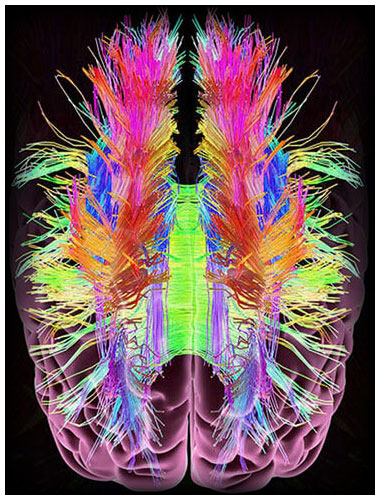
TBI Scan

WHAT IS A TRAUMATIC BRAIN INJURY (TBI)

A traumatic brain injury, or TBI, is an injury that affects how the brain works. TBI is a major cause of death and disability in the United States. Anyone can experience a TBI, but data suggest that some groups are at greater risk for getting a TBI or having worse health outcomes after the injury.

There were about 61,000 TBI-related deaths in the United States in 2019. That comes to roughly 166 TBI-related deaths every day. TBIs affect the lives of people of all ages. Anyone can experience a TBI, but data suggest that some groups are at greater risk of dying from a TBI or experiencing long-term health problems after the injury.

While sports injuries, including repetitive concussions, are known causes of traumatic brain injuries, automobile accidents are another major cause of TBI’s. The most widely reported brain injuries from car accidents result from vehicle rollovers or occupant ejection. Car accidents are the second leading cause of TBIs, making up 17.3% each year, right after falls, which make up just over 35% of traumatic brain injuries. These often lead to catastrophic brain injuries, including skull fractures and other similar major traumatic injuries.

The majority of 18-wheeler truck wrecks will involve some level of traumatic brain injury. Traumatic brain injuries (“TBI”) occur when a bump, blow, or a jolt to the head disrupts the normal function of the brain.
brain scan

Surprisingly, a much more common cause is from a rear-end collision. Most of these brain injuries do not involve obvious trauma like a skull fracture or facial wound. The serious whiplash of the head back and forth due to a violent rear-end collision can cause a life altering brain injury (physicians refer to this injury as a “contrecoup” injury (where the brain contacts the front of the skull and back of the skull due to the whiplash forces).

A contrecoup TBI can injure blood vessels in the brain and cause a slow bleed, which can create pressure that contributes to brain damage and even death. Or the bleeds and tears may be microscopic in nature, but nevertheless have serious consequences on the higher (executive level) functioning of the brain. Contrecoup brain injury involves a contusion remote from, and opposite to, the actual site of impact to the head. A Contrecoup brain injury is an injury mainly prevalent in truck accidents given the large force of a rear-end collision from a commercial truck or tractor-trailer.

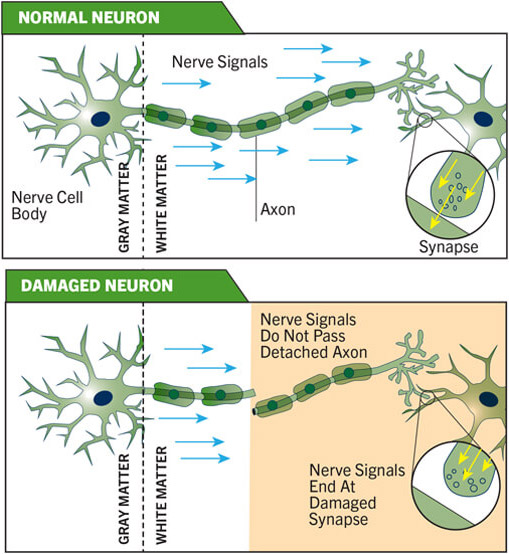
These injuries cause the neurons (transmitters) of the brain not to be able to relay the electrical messages of the brain as efficiently or quickly—leading to problems with memory, problem solving, emotion control and impulse control. These injuries can have lasting consequences.

normal neurons

TRAUMATIC BRAIN INJURY SYMPTOMS

Traumatic brain injury often occurs as a result of a severe sports injury, car accident, or 18-Wheeler accident. Immediate or delayed symptoms may include confusion, blurry vision, and concentration difficulty. Infants may cry persistently or be irritable.

Unlike other injuries, the full impact of a traumatic brain injury (TBI) may not be fully known at the time of the accident or even at the time of treatment.

Symptoms may appear days or weeks after an initial diagnosis, and could result in additional − and often expensive − medical treatment. Therefore, if you or a loved one has suffered a head injury due to the negligence of another, you should consult with an experienced personal injury attorney right away to ensure all your expenses − both now and in the future − are protected.

Symptomatic Experiences:
  • Cognitive: amnesia, inability to speak or understand language, mental confusion, difficulty concentrating, difficulty thinking and understanding, inability to create new memories, or inability to recognize common things
  • Behavioral: abnormal laughing and crying, aggression, impulsivity, irritability, lack of restraint, or persistent repetition of words or actions
  • Mood: anger, anxiety, apathy, or loneliness
  • Whole body: blackout, dizziness, fainting, or fatigue
  • Eyes: dilated pupil, raccoon eyes, or unequal pupils
  • Gastrointestinal: nausea or vomiting
  • Speech: difficulty speaking or slurred speech
  • Visual: blurred vision or sensitivity to light
  • Also common: persistent headache, a temporary moment of clarity, balance disorder, bleeding, bone fracture, bruising, depression, loss of smell, nerve injury, post-traumatic seizure, ringing in the ears, sensitivity to sound, or stiff muscles

PHYSICAL SIGNS OF TBI DAMAGE

  • Headache - Dull or sharp pain within the skull. Can occur anywhere with the cranium including areas away from the point of injury
  • Pain around or above the neck - Normally associated with whiplash. The head does not have to be hit for internal damage to occur. The brain tissue is harmed when hitting the inside of a person’s skull
  • Bleeding or bruising to any part of the head - Most obvious sign of minor to severe TBI. This includes nose bleeds, cuts or deep bruising to the face, neck or head
  • Hearing issues - People can lose hearing in one or both ears, hear ringing or high pitched noises that are not present
  • Eyesight problems - Dizziness, Blurred vision, seeing spots or blind spots. People have a hard time focusing or experience changes to vision after knock to head
  • Jaw pain - Normally occur from an act of violence or punch. A blow to the jaw can transfer force to skull resulting in damage to brain
  • Nausea or Vomiting - Similar to motion sickness or seasickness effect. People feel off balance indicating internal damage to the head

MENTAL SIGNS OF TBI DAMAGE

  • Confusion - People are easily confused or disoriented. They can’t remember basic information
  • Changes in mood - Agitation and combativeness levels are higher
  • Mental Status - Days and weeks after an incident a person’s normal behavioral patterns change. Become more aggressive, depressed or anxious
  • Sensitivity to light & sound - Normal sounds and well-lit rooms cause irritation, headache or pain. Suffers of TBI will prefer dark quite rooms

TYPES OF BRAIN INJURIES

When a doctor's mistake (Medical Malpractice) or simple inattention allows a treatable medical condition to result in permanent brain damage, the Traumatic Brain Injury Attorneys at Miller Weisbrod, Attorneys At Law are here to fight for full financial recovery for the victims and their families. Based in Dallas, we serve clients throughout Texas and nationwide.

Head injuries are categorized in three types - Mild, Moderate and Severe. These can have multiple symptoms in common.

Mild Brain Injury
  • Concussion resulting in changes to your mental status
  • Loss of consciousness from 0 to a maximum of 30 minutes
  • Confusion, dizziness, fatigue, memory loss, mood changes and headaches
  • Medical exams and tests (MRI & CAT Scans) may not show damage

Moderate Brain Injury
  • Concussions and Mild symptoms will be present. These issues will last longer and get worse overtime
  • Loss of consciousness from 15 minutes to 5 hours
  • Same symptoms of mild injury but worse
  • Medical exams and brain scans will be used reveal brain tissue damage

Severe Brain Injury
  • Loss of consciousness for more than 5 hours
  • Obvious swelling of head
  • Results in permanent neuro-biological damage
  • Results in a permanent lessening of cognitive abilities and sensory functions
  • Medical exams MRIs & CAT scans will necessary to assess extent of and area of damage
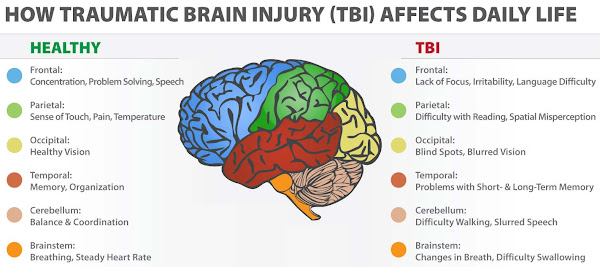
TBI chart

TRAUMATIC BRAIN INJURY TREATMENTS

Treatments for TBIs depend on the severity of symptoms. Treatment may involve rest, medication, or surgery.

MEDICATIONS
Medications include diuretics that help eliminate extra water from the body. It's also prescribed to treat high blood pressure.

SURGERY
Depending on the severity of the injury, a decompressive craniectomy may need to be performed. This is the surgical removal of part of the skull so that an injured brain can swell without being squeezed.

THERAPY
Rehabilitation is the retraining the brain's pathways to improve mental and physical functioning after an illness or injury.

Cognitive behavioral therapy is a talk therapy focused on modifying negative thoughts, behaviors, and emotional responses associated with psychological distress.

Anger management therapy includes practicing mindfulness, coping mechanisms, and trigger avoidance to minimize destructive emotional outbursts.

Counseling psychology is a branch of psychology that treats personal problems related to school, work, family, and social life.

If you notice any of these symptoms, or if you just can’t think clearly after a car accident, then seek medical attention immediately. You should also consult a personal-injury attorney as soon as possible.

CONTACT MILLER WEISBROD

Miller Weisbrod has dozens of million and multimillion dollar verdicts and settlements on behalf of clients who have suffered all levels of TBI. Our demonstrated trial experience and proven record of results are just some of the many reasons clients continue to turn to us in their time of need.

Among other notable cases, Miller Weisbrod recovered $4,250,000 on behalf of a passenger in a truck who suffered a catastrophic brain injury as a result of being forcibly ejected from a truck in a serious motor vehicle accident as well as $1,500,000 for a client injured in a construction/worksite accident after falling from an unstable work platform.

To schedule a free case evaluation regarding your Traumatic Brain Injury (TBI), please contact our office in Dallas at 214.987.0005 or toll free at 888.987.0005. You may also contact us by filling out the form on this page for answers to your questions or to schedule an appointment.

Personal Injury Lawyer Clay Miller

Friday, July 30, 2021

18-Wheeler Under-Ride Accidents

Under federal regulations set by the Federal Motor Carrier Safety Administration (FMCSA), all commercial semi trucks, 18-wheelers, tractor-trailers and other big rigs are required to have underride protection. Underride protection consists of metal guards placed at certain points on the sides and back of the vehicle's undercarriage to prevent passenger vehicles from slipping underneath the trailer in a truck accident.

Failure to provide underride protection can result in catastrophic injuries to occupants of other motor vehicles, including severe head injuries, brain damage, spinal cord injuries, decapitation or death. According to the most recent statistics posted by the National Center for Statistics and Analysis (NCSA), a division of the National Highway Traffic Safety Administration (NHTSA). In fatal car-truck accidents, 90% of rear impact, and 70% of side-impact were determined to be Underride related.

Causes and Prevention of Underride Accidents
When a car comes in contact with the undercarriage of a semi truck or tractor-trailer, the passenger compartment can be crushed or even completely torn off, greatly increasing the potential of catastrophic or fatal injury. Underride accidents occur most often because of:

  • Poor visibility at night due to improper lighting or reflective systems or in adverse weather conditions
  • Truck driver inattention such as failing to check blind spots when changing lanes, thereby running over a smaller vehicle in the passing lane
  • Defective rear guards in a rear-end collision
  • Multicar pileups in which one car is accidentally pushed under the truck by another

To prevent underride accidents, federal regulations require that all commercial trucks over a certain weight maintain lighting systems or reflective gear so other drivers can clearly identify the truck bed or carriage at night or during inclement weather. Certain vehicles may also be required to equip the back or sides of the trailer with a lower mounted guard to prevent underride in a rear-end collision or sideswipe.

Proven Results on Behalf of Bereaved Families

Your family has the right to pursue compensation from those responsible for the financial loss and emotional distress you have endured. We bring our demonstrated trial experience, wealth of resources and in-depth knowledge of commercial vehicle regulations to every case we handle. We have obtained substantial multi-million dollar recoveries on behalf of families across the nation.

$8.75 million from a major trucking company that was responsible for the deaths of two Mexican nationals

Contact Miller Weisbrod, Attorneys At Law
The experienced Fatal Truck Wreck Attorneys of Miller Weisbrod, Attorneys At Law represent families, nationwide, who have suffered irreparable loss due to truck driver errors. Our firm is the leader in the fight to hold national transport corporations responsible for practices and policies that make our highways unsafe. We are available for consultation nationwide. Feel free to call us toll free at 888.987.0005.

Monday, December 9, 2019

Areas producing oil, gas in Texas see more crashes


By JOHN C MORITZ
By Corpus Christi Caller-Times

AUSTIN — Danielle Galvan was driving to Dallas from her parents’ home in the Panhandle when her compact Chevrolet Spark crashed into the rear of a tractor-trailer that was attempting to back up onto U.S. 287 about 10 miles west of Wichita Falls.

The 23-year-old aspiring fashion designer and model died in the fiery wreck on the night of March 6, 2018, leaving behind two children and a grieving extended family in Hereford, southwest of Amarillo.

The crash that claimed her life occurred on a highway that connects some of the largest and busiest oil- and gas-producing regions of Texas to the sprawling population center anchored by Dallas and Fort Worth.

Galvan was among the 1,673 people who lost their lives in 2018 while motoring through one of Texas’ five largest oil and gas plays, according to figures compiled by the Texas Department of Public Safety. That’s about half of all traffic fatalities in the state and represents a grim downside to the Texas resurgent energy sector that is helping to propel the state’s booming economy.

“It’s very scary out there right now,” said Richard Minnix, the owner of McClatchy Brothers, a Midland trucking company that serves the booming and oil-rich Permian Basin. “The biggest problem is distracted driving. It’s jacking with your cell phone, text messages.”

If you have been involved in a truck accident caused by distracted driving, contact Miller Weisbrod, Attorneys At Law right away to protect your right to just compensation. Immediate investigation and swift legal action may be required to protect your rights against trucking company and insurance carrier investigators who seek to limit their responsibility to pay.


The TxDOT figures still show speeding as the No. 1 cause of crashes in Texas, with distracted driving close behind. Lawmakers in 2017 banned texting and driving in Texas, but the crash rate still increased during the first year the law went on the books.

James Bass, TxDOT’s executive director, said driving conditions, especially in the energy-producing parts of the state, have changed dramatically with the uptick in production.

“A big increase in the number of heavy trucks and traffic on state and county roads adds to the complexity of driving — something we always need to give our full attention to, while also obeying traffic laws,” Bass said.

John Esparza, who heads the Texas Trucking Association, said trucks are to blame for only a fraction of the wrecks — both in the oil patch and statewide — even if crashes involving big rigs tend to draw an outsized share of news coverage.

Still, he said, much of the oil and gas production is taking place in rural Texas, where roads were built to accommodate less traffic.

“We’re becoming more and more congested, and there are more and more fatalities that involve everyone because some of the simplest things we are not doing well,” Esparza said. “And you throw trucks in the middle of all of that, you are seeing more trucks involved in that area in a disproportionate amount than they are for the whole rest of the state.”

The sprawling Permian Basin, which covers much of West Texas and extends into New Mexico and is perhaps the nation’s biggest producer of oil and gas, saw 485 highway deaths and 1,321 serious injuries in 2018. The number of traffic crashes increased 13% from 2017 and the fatalities jumped 20% from 2017.

But those figures run behind the more urbanized Barnett Shale, which includes Fort Worth and its suburbs and extends to the Wichita Falls area. Last year, 710 fatalities and 3,400 serious injuries were reported from crashes in the Barnett Shale.

Both Esparza and Minnix give TxDOT high marks for improving roads and expanding capacity in West Texas and in the other high-producing regions. The challenge is keeping up with the traffic needed to get workers and equipment to the oil fields, and to get the product to the market.

In Pecos, about 100 miles to the southwest and about 200 miles east of El Paso, oilfield activity is causing unheard-of traffic jams on the two-lane blacktops leading in and out of town.

The trucking association is helping TxDOT with a public-education initiative called "Be Safe. Drive Smart" that is aimed at the state's energy-producing regions. The campaign reminds drivers to:

• Always buckle up. That includes drivers and all passengers.
• Take into account the amount of traffic, road conditions, and weather when gauging how fast to drove.
• Put your phone away: no talking or texting when you're behind the wheel.
• Give large trucks plenty of space, and pass only when it's safe and legal to do so.
• Obey stop signs and traffic signals.
• Never drive under the influence of alcohol or other drugs.

Wednesday, February 21, 2018

What To Do If You Are Involved In A Trucking Accident


When a truck collides with a passenger vehicle, the result can be devastating. Those traveling in the passenger vehicle are likely to be seriously injured or tragically killed in the collision. In the moments after such an accident, you may not know what to do. First and most important is your health. The next steps will either help or hurt your chances of successfully filing a personal injury claim.

1. Get Medical Attention Directly After The Accident
Statistically, all impacts will result in some kind of bodily injury and/or pain. The most important thing is to get the medical attention you need. Even if you have no apparent injuries, see a doctor anyway. Some injuries take days to become physically apparent. There may be internal damage, or the adrenaline in your body prevents you from realizing your injuries until later on. A visit with a doctor will serve as documentation of your injuries if you decide to file a claim.

2. Call 911
Whether the accident is minor or serious, it is a good idea to call the police to the scene. Have the officer generate a report detailing the accident. A police report will serve as valuable evidence when you decide to file a claim against the trucking company. You can obtain a copy of the police report by calling your local police department. Keep a copy for yourself. The insurance company will also want a copy if you are filing a claim.


3. Take Pictures & Write Down Details
If you can, take photos of the accident scene. Photos of the scene will help determine who is at fault, as they will show the positions of the vehicles. Pictures also serve as proof of damages to your vehicle. Take the photos as soon as possible and before either vehicle is moved. Accident reconstruction specialists can use your photos to create a model of the accident and provide an opinion on who was at fault for the collision. Along with taking photos, gather contact information of witnesses if possible. Their account of the accident may benefit you if you make a claim.

If you are injured and need medical attention, do not stop to take photos. Get medical attention immediately.

4. Get A Lawyer
Getting a lawyer involved immediately will help preserve evidence. Lawyers will be able to secure evidence that otherwise might be lost if there is a delay. If you are injured in the accident, hire a lawyer. You may be able to obtain compensation for the following:

  • Medical Bills
  • Lost Wages
  • Pain & Suffering
  • Loss of Companionship
  • Special damages: which includes other monetary losses after an accident
In order to win a case like this, you will need to prove the trucking company and the driver were liable for your injuries. The trucking company that employs the driver may be held responsible through “Vicarious Liability”. Vicarious liability means that employers are responsible for accidents their employees get into while on the job.

Contact Us
If you were hurt or a loved one was severely injured or died in a trucking accident, immediate investigation and concerted legal action may be necessary to protect your right to seek maximum recovery. Contact us today for a free consultation. At Miller Weisbrod, our clients are not statistics — they are real people in need of proactive, aggressive representation to defend their rights. Our Dallas truck accident attorneys are prepared to take on even the biggest trucking companies and commercial transportation operations across the United States. For more information, contact our offices in Dallas at 214.987.0005 to schedule an appointment.

Monday, December 4, 2017

Have you been injured in a sideswipe accident with an 18-Wheeler?


Semi-trucks are huge vehicles that can weight upwards of 80,000 lbs. Because of this, accidents involving 18-wheelers tend to be catastrophic, often resulting in severe injuries or even wrongful death. 18-wheelers are a common sight on Texas roads, but when a truck driver causes an accident due to negligence, do NOT expect the insurance company to treat you fairly.

Truck accident injury claims are defended vigorously. Insurance companies have gotten really good at shooting down or minimizing claims. Because of the high policy limits on commercial trucks, adjusters often go to great lengths to limit the value of your claim. They may claim that you should have done your part in ensuring that the trucker was aware of your presence, or they may call into question your driving record and pick out a ticket you received five years in order to show that you’re a bad driver.

As truck accident attorneys, we see these tactics used all the time. Even worse, we talk to many victims who were strung along by the insurance company only to find out several months later that their claim has been denied. Unfortunately, by the time these people reach out to us, it’s often too late in the process for an attorney to help.

It is important to get in touch with an experienced truck accident law firm immediately if you’ve been injured in a truck accident. While property damage claims are usually pretty straight forward, the same cannot be said for an accident injury claim (especially those involving commercial trucks). There is no harm in having someone in your corner to advocate for your best interests and navigate the claims process, and it costs you nothing out of pocket to hire us.

18-Wheelers have massive blind spots

A blind spot is simply an area within a field of vision that cannot be seen by a driver due to the shape of the vehicle or the angle of the side mirrors. As a result, truck drivers are trained to approach highway off-ramps with care, and to change lanes only when it is absolutely certain the other lane is clear.


While we never recommend driving directly next to an 18-wheeler for an extended period of time, do not allow them to blame you (even partially) for their own act of negligence. Truck drivers are still governed by the same traffic laws as everyone else (FMCSA regulations), and you deserve to be fairly compensated.

Common sideswipe accident scenarios:
  • Poor driver training can cause Dallas truck drivers to operate vehicles in a reckless manner
  • Driver distraction is a huge cause of Dallas 18-wheeler accidents. This can be due to the truck driver messing with the radio controls, watching TV while driving, talking on the phone, and engaging in activities which take their attention away from the task at hand
  • Tire blowouts happen every once in a while, and may be the result of inadequate maintenance, product liability, or due to a mismatched tire
  • Driver intoxication is another common cause of sideswipe accidents in Dallas, including drivers impaired by alcohol, stimulants, pain killers, or illegal narcotics
Sideswipe crashes can be dangerous because they can result in underride accidents, rollovers, and jackknifing. Passenger vehicles involved in sideswipes are often pushed off the road or into incoming traffic.

Contact us today!
If you were hurt or a loved one was severely injured or died in a trucking accident, immediate investigation and concerted legal action may be necessary to protect your right to seek maximum recovery. Contact us today for a free consultation.

At Miller Weisbrod, our clients are not statistics — they are real people in need of representation to defend their rights. Our truck accident attorneys are prepared to take on even the biggest trucking companies and commercial transportation operations across the United States. For more information, contact our offices in Dallas at 214.987.0005 to schedule an appointment.

Thursday, April 27, 2017

Exploring the other "Why" in Trucking Accidents: Trucker Health Issues


Last month, we focused on lack of sleep and fatigue leading to an impaired truck driver on the road. While fatigue is probably the leading cause of impairment in commercial truck drivers, untreated or unmanaged health issues can also lead to a dangerously impaired driver behind the wheel of an 80,000 lb. tractor-trailer.

Health issues have long been a concern of the trucking industry. As a result of the sedentary nature of the job, many truck drivers have serious and chronic health conditions that can affect their ability to operate a commercial vehicle, especially if the conditions are not properly treated or managed. When investigating the “Why” of an 18-wheeler case do not forget to explore the possibility of health issues as one of the reasons of why a wreck occurred.

Some of the common health conditions that can lead to an impaired driver include:
  • Untreated sleep apnea—leading to a fatigued driver
  • Uncontrolled diabetes—leading to a driver with altered mental status
  • Mismanaged high blood pressure—leading to a variety of issues including syncope (blacking out)
  • Lung or cardiac conditions—that can lead to a multitude of medical emergencies that can cause a wreck
The trucking industry has recognized sleep apnea as a pervasive condition throughout the industry that has contributed to an increased number of fatigued drivers on the road. There have been numerous studies about the effects of untreated sleep apnea on truck drivers and how this condition can lead to inadequate sleep. Make sure to inquire about not only pre-incident diagnosis and treatment, but post-incident diagnosis as well. We have found many times a wreck has led the driver (or even the company) to finally react to the previous signs of sleep apnea.

When exploring other chronic conditions as a causative factor of a wreck, consider subpoenaing the pharmacy records of the driver to see if they were filling prescriptions for medications necessary to control the condition. We have seen over and over, large gaps in the filling of blood pressure, diabetes and other medications for medical conditions that provide strong evidence of an impaired truck driver.

If it is possible to obtain a TRO or other “hold” on the cab of the truck, you may find a goldmine of evidence. We have found expired prescription bottles, prescriptions for conditions never disclosed before and other important evidence to aid in the proof of an impaired driver.

Obtaining medical records of a truck driver you suspect of being impaired by a medical condition is paramount. Many times this requires the use of an out of state subpoena which can be time and labor-intensive, but the results are often critical. The records may show the truck driver was warned of their condition and ignored the warning or recommendations for the treatment/management of the condition.

Below is clip from a case where we discovered the driver had been warned about having the symptoms of a serious cardiac/lung condition but failed to follow up with diagnostic testing and later “blacked out” while on the road but tried to blame the event on a coughing fit.


Miller Weisbrod handles tractor-trailer accidents resulting in serious injury and death all across Texas and the United States. We would welcome the opportunity to put our experience and resources to work for you and your clients through a variety of arrangements including referrals or joint ventures.   

 
  Les Weisbrod & Clay Miller


Miller Weisbrod is now reviewing and filing
Xarelto cases. 

If you know someone that
has been hospitalized for
any period of time due to
a bleeding event while on Xarelto, please contact us
for a consultation.

For more information 

click here.


Dallas Office (Main)

11551 Forest Central Drive


Suite 300


Dallas, TX 75243
Map and Directions

Houston Office
 

6200 Gulf Freeway


Suite 410

Houston, TX 77023

Map and Directions

Austin Office


5407 N. IH 35, Ste 304
Austin, TX 78723
Map and Directions

Contact Information

Toll Free: 1.888.987.0005


Local: 214.987.0005


Fax: 214.987.2545


Learn about our firm's birth injury practice here:
www.birthinjurynews.com
 
Learn about our firm's commercial trucking practice here:
www.18wheelerlaw.com
 
Learn about our firm's defective drug/medical device practice here:
www.badpharmalawyer.com


Copyright © 2017, Miller Weisbrod LLP, All rights reserved.