Showing posts with label work site injuries. Show all posts

Monday, August 16, 2021

Dangerous Scaffolding Accidents

Dangerous Scaffolding
According to the Bureau of Labor Statistics (BLS), scaffolding accidents result in 4,500 injuries and over 60 deaths each year and that almost 30 percent of all workplace deaths from falls involve scaffolding or ladders. These accidents are 100% preventable if workplace safety regulations are followed.

Leading Factors in Scaffolding Accidents:

  • Defective or faulty scaffolding (either through manufacturing or design)
  • Falling debris
  • Faulty inspection of scaffolding
  • Uninspected scaffolding
  • Overloaded scaffolding
  • Lack or improper use of scaffolding safety equipment
  • Failure of scaffold parts (i.e. wires, bracing, guard rails, planks, etc.)

Construction and industrial sites often use scaffolding to reach upper levels of buildings. While scaffolding is commonly used to allow workers to safely access high rise infrastructures, they can also cause severe injuries as there are several hazards associated with their use.

Many times, scaffolding is missing important items like bracing that prevents workers from falling. Other common problems causing dangerous scaffolding involves the failure to place the proper footing on the scaffolding allowing it to become unstable and even collapse.

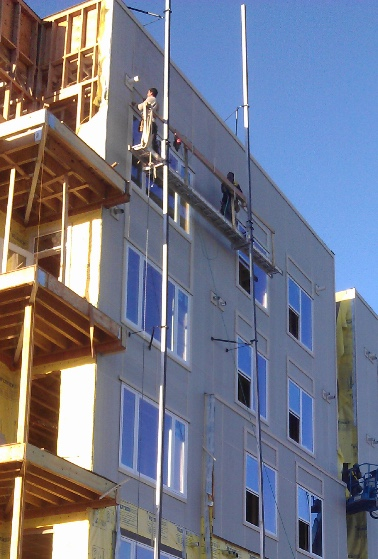
Some specialty trades use scaffolding called “pump jacks” to reach upper levels of a building under construction or undergoing maintenance/repair work. These scaffolding must have the appropriate bracing in place on the support poles or they can collapse or tip backwards from the building.

Our client, while working for the City, fell when the scaffolding collapsed due to faulty components. He is now paraplegic. Our Personal Injury Lawyers obtained a recovery of $5,000,000.00

Common Scaffolding Injuries Scaffold collapse injuries can range in severity. It is not uncommon for us to see the following injuries after a scaffolding incident:

  • Spinal cord injuries including paralysis
  • Traumatic brain injuries
  • Broken or dislocated bones
  • Severe lacerations or punctures
  • Loss of or damage to a bodily organ
  • Significant disfigurement
  • Amputations

Each of these injuries requires extensive medical attention. Not only will this lead to major medical bills, but the injured person may not be able to work while they recover. Lost income could jeopardize the financial stability of their family. If a scaffold accident victim is disabled, they may require lifelong care.

Safety Standards The Occupational Safety and Health Administration (OSHA) publishes regulations on scaffold safety, including how to construct, maintain, and use scaffolds.

In addition, many private organizations publish scaffold safety standards. Violations of these standards can be used as evidence of negligence in personal injury cases resulting from scaffold accidents.

Experienced Representation Against Insurance Companies Employees who have suffered an injury in a workplace accident find that insurance companies are often quick to offer settlements, or pressure them into signing waivers that limit their rights. Our Work Injury Attorneys have significant experience taking on big insurance companies or liable third parties, and defend our clients' right to receive full and fair compensation.

The Dallas Work Injury Lawyers of Miller Weisbrod offer informed counsel and experienced representation to clients in Texas and nationwide. To discuss your case in a free initial consultation with an experienced lawyer, please fill out the contact form on this page to schedule an appointment. You can also call us directly at 214-987-0005 or toll free at 888-987-0005.

Dallas Work Injury Lawyer Clay Miller

Wednesday, June 1, 2016

Miller Weisbrod Settles Construction Accident - Dangerous Pump Jack


Our clients were siding contractors on a large apartment construction project in South Central Texas. In order to place large pieces of pre-fabricated siding, the workers needed to have an elevated platform to work at the necessary heights. Since the work involved moving horizontally along the face of the building, stationary scaffolding did not make practical sense because it takes so long to erect, disassemble and move. Instead, the typical aerial platform for this and similar trades is called a pump jack.


This device utilizes two horizontal metal poles and a platform that can be lifted or “jacked” up and down to the necessary heights to perform the work.

OSHA generally requires independent lifelines connected to harnesses unless an adequate guardrail system can surround the entire work platform. But in many cases, the pump jack must be placed inside crevices in such a way that a smaller platform without guardrails is utilized. Industry practice is that a bolt is placed at the top of a building so the workers can hook long lanyards/lifelines to hang down and attach to their harnesses. This allows protection should the platform fail or become unstable.

In our case, the superintendent for the general contractor knew about the industry standard and claimed that the siding contractors were always tied off when on the pump jacks (that did not have proper guardrails). Our clients claimed they never had been issued harnesses and there were no hard points for lifeline connection on the roof of the apartments. They had been working for three weeks when their platform became unstable (due to inadequate bracing) causing them to fall over the side. One client suffered several orthopedic fractures — the other suffered a broken spinal cord leaving him permanently paralyzed.

The problem was collectability — our clients were hired by Edwin, who was hired by Raul, who was hired by Jessie who was hired by a company in Kansas that had the siding subcontract but had never visited the job site or met in person Jessie, Raul, Edwin or our clients. The Kansas company had been contracted by the General Contractor on the job.

Our theory was that the general contractor knew that the lack of fall protection was dangerous and approved the practice by failing to require fall protection even though they walked by the workers a half dozen or more times every day for several weeks.
Cross examination of the job superintendent:


On the strength of this cross examination and other admissions from the general contractor’s employees were able to secure a substantial confidential settlement that will provide for the life care needs of our paralyzed client and compensated his co-worker for his orthopedic injuries.

Miller Weisbrod has partnered with law firms across the state of Texas on a referral and joint venture basis to pursue cases of catastrophic injury and wrongful death arising from construction and work site incidents. We would welcome the opportunity to work with you to obtain justice for your clients injured or killed on the job.

Miller Weisbrod, LLP is a national law firm specializing in catastrophic injury and wrongful death cases. Partners Clay Miller and Les Weisbrod have built the firm’s reputation with successful verdicts, settlements, appeals and favorable decisions across the country. With resources and finances available to take on the powerful interests that have caused harm, the firm is committed to providing quality representation for clients who are seriously injured and families of victims who are killed as a result of the negligence or misconduct of others.

Miller Weisbrod has offices in Dallas and affiliate offices in Houston and Austin. For more information call toll-free at (888) 987-0005.

Friday, May 6, 2016

Construction Worker Freed From Trench


IRVING, TEXAS — Crews were able to a free a construction worker more than three hours after he became stuck in a 15-foot trench in Irving. The accident was reported at about 2:52 p.m. Thursday (5/5/16) in the 2100 block of Ridgewood Street.


At about 6:20 p.m., the worker, strapped onto a gurney, was pulled from the trench and placed into a ground ambulance in unknown condition.

Trench Accident Lawyers
Working in trenches or other contained breathing areas is one of the most dangerous jobs in the construction industry. Contractor and subcontractor negligence and OSHA safety violations can turn an already hazardous situation into a recipe for a serious and fatal trench accident.

Miller Weisbrod, LLP serves the legal needs of construction accident victims and their families in Texas and nationwide. Our attorneys are nationally-recognized leaders in the field of plaintiffs' personal injury trial law. We have the experience, skills and resources to help you seek maximum financial recovery after a trench accident results in catastrophic injury or wrongful death due to a trench accident.

If you were badly hurt or permanently disabled or a loved one died in a trench accident anywhere in the United States, please contact us today to schedule a free consultation with an experienced lawyer.

Call 888.987.0005 for Legal Help After a Trench Accident

Miller Weisbrod, LLP has a proven record of success in obtaining large financial settlements and jury awards for victims of negligence. Our lawyers have the experience, industry knowledge and legal skill to handle a wide range of trench accident cases, including:

• Broken natural gas lines leading to suffocation or explosion
• Trench collapse accidents caused by improper shoring and supports
• Water infiltration resulting in drowning
• Accidents in other enclosed spaces such as manholes, sewers, storm water drains and tunnels
• Any trench accident resulting in brain injury, spinal cord injury, other catastrophic injury or wrongful death

Contact Us
If you were seriously injured or a loved one died in a trench accident caused by contractor negligence or OSHA violations, we encourage you to call our main offices in Dallas today at 214.987.0005 or toll free at 888.987.0005 for a free consultation. You may also contact us by e-mail today for answers to your important questions or to schedule an appointment.

Wednesday, March 2, 2016

Demolition Construction Accident Verdicts


Some of the most hazardous construction operations involve the demolition of structures. In June of 2013, a building being demolished in Philadelphia collapsed onto an adjacent structure killing a half dozen people and seriously injuring more than a dozen more. This case brought to the front page news what our firm has seen time and time again in demolition construction accidents—there is no requirement under most state and local ordinances requiring a company obtaining a demolition permit to show any level of competence.

Several of our cases have highlighted this sad fact. Two years ago, a young husband and father was killed when a two-story chimney on house he was demolishing on the TCU campus collapsed on top of him. Our lawsuit against the employer revealed the company was a paving contractor that had only ever demolished portable buildings (cheap mobile home structures used at schools for temporary classrooms) on a single occasion. But when this paving company applied for a demolition permit from the city of Fort Worth to demolish nearly a dozen brick buildings (including a large church and a two story apartment building) no inquiry at all was made into the qualifications of a company that spent its entire time building and paving parking lots. When deposed, the company’s owner and superintendent admitted none of the crew, including the deceased, had any experience before the day of the collapse in demolition. He also admitted that he was completely unaware of any of the OSHA or industry demolition safety standards and he had no written demolition plan for any of the structures.


The remains of the demolished house on the TCU campus

Subpart T of the OSHA construction safety standards lays out the minimum requirements for demolition safety.

The very first section of the standard requires that an “engineering survey” be performed by a competent person before demolition operations begin. The stated purpose of this standard is to prevent any “unplanned collapse” during the demolition of the structure that could endanger workers or bystanders. This standard is almost universally violated in every demolition lawsuit we have pursued—usually because an inexperienced or incompetent company decides to take on a demolition job that it is not qualified to perform.

But this failure to perform engineering surveys is not just ignored when a paving company decides to become a demolition subcontractor. In another case, an actual demolition contractor failed to perform an engineering survey prior to beginning operations. As roof joists were being cut, the building collapsed upon other workers killing our client. What is unforgivable is that our investigation revealed the company had been cited by OSHA 3 years earlier for failing to perform an engineering survey during a surprise inspection by OSHA. Here are excerpts of our cross examination of the demolition company’s safety director that was hired just months after the first citation:


Following this deposition, we settled the gross negligence only death case (the employer had workers’ compensation insurance) for the full amount of all available insurance.

Contact Us
Miller Weisbrod has partnered with law firms across the state of Texas on a referral and joint venture basis to pursue cases of catastrophic injury and wrongful death arising from construction and work site incidents. We would welcome the opportunity to work with you to obtain justice for your clients injured or killed on the job.

Contact our office in Dallas at 214.987.0005 or toll free at 888.987.0005. You may also contact us by e-mail today for prompt answers to your questions or to schedule an appointment.

Tuesday, February 9, 2016

Miller Weisbrod Wins $3,000,000.00 Arbitration Award


One of the highlights of 2015 for Miller Weisbrod was a $3,000,000 Arbitration Award for a man that lost his right hand as a result of a work place injury. Greg Turner was working at a local chocolate/candy factory operating an industrial chocolate mixer. While dumping melted chocolate from plastic buckets while the mixer was turning, he accidentally dropped a bucket into the mixer. Turner then reflexively reached into the mixer to retrieve the bucket. The blades of the mixer caught Turner's right hand taking it into a pinch point on the side of the mixer severing the hand at the wrist. A surveillance video caught this incident partially on tape — though the point of operation was obscured by the lid of the mixer.


Surveillance image

Turner's employer was a non-subscriber to worker's compensation. The employer had an injury benefit plan but denied Turner benefits because a post-accident drug screen showed amounts of two drugs in his system. Our firm filed suit and the case was removed to arbitration because the plan signed off on by Turner included an Agreement to Arbitrate.

Our claims of negligence involved the failure of the mixer to have an adequate guard over the opening of the mixer or, more practically, to have a lock-out device on the mixer that would shut the mixer off when the lid was lifted. Through deposition questioning, the Defendant's supervisors admitted that it was not necessary to have the lid open and the mixer on and turning while loading the chocolate. Our position was that the machine should be loaded with the machine off-but the company had trained all employees to load the mixer while it was on and turning. In fact, the surveillance video showed Turner's supervisor watching him for an extended period of time loading the mixer while it was on and turning.

The employer claimed that risks of the mixer were open and obvious and that it had warned Turner of the risks of sticking his hands into the machine; therefore, there was no duty to take additional precautions. In support, they cited numerous cases in the premises liability context that affirmed this position. We took the position that the instrumentality (the mixer) was dangerous and this was a separate duty in the non-subscriber context. The arbitrator agreed with this argument and denied a "no duty" motion. The Texas Supreme Court has recently also agreed with our position in a similar case Austin vs. Kroger Co., 465 S.W.3d 193 (Tex. 2015)

The Defense hired two main experts including a safety expert arguing against the need for a lock-out device. This expert was revealed to have no experience in machine guarding and expressed some irrational opinions that we pushed on to destroy his credibility. The second expert was a well-known prosthetic expert who advanced the theory that Medicaid was the industry standard for reasonable of charges for prosthetics and arguing that instead of a myeo-electric hand our client should get a hook and a rubber hand. We showed that he had been "out of the game" as far as upper limb prosthetics and that his "opinion" that Medicaid was the industry standard for billing rates was not supported by anything other than his word and then at arbitration confronted him with a prior case where he had taken the opposite position when hired by the plaintiff.

Below are a couple of short examples of the deposition cross examination:


At the Arbitration we proved that all the co-employees who encountered Turner on the day of the incident found him not to be impaired — eliminating the drug screen argument.

At the end of the hearing, the Arbitrator issued an award finding negligence and damages in the amount of $3,044,888.33. Miller Weisbrod has partnered with law firms across the state of Texas on a referral and joint venture basis to pursue cases of catastrophic injury and wrongful death arising from construction and work site incidents. Miller Weisbrod would welcome the opportunity to work with you to obtain justice for your clients injured or killed on the job.

Miller Weisbrod,LLP is a national law firm specializing in catastrophic injury and wrongful death cases. Partners Clay Miller and Les Weisbrod have built the firm’s reputation with successful verdicts, settlements, appeals and favorable decisions across the country. With resources and finances available to take on the powerful interests that have caused harm, the firm is committed to providing quality representation for clients who are seriously injured and families of victims who are killed as a result of the negligence or misconduct of others. Miller Weisbrod has offices in Dallas and affiliate offices in Houston and Austin. For more information call (888) 987-0005 or visit www.millerweisbrod.com

Tuesday, November 17, 2015

Texas Oil Boom : Death Toll


Accidental deaths rising during Texas oil boom
Texas had half of the country's oil field deaths last year - 71 of the 142 workers who died in the hunt for hydrocarbons, new data from the U.S. Bureau of Labor Statistics and the Texas Department of Insurance indicate.

In the five years between 2010 and 2014, 615 U.S. oil field workers died. Of those, 270, or 44%, were in Texas.

In Texas, workers have been hit by falling equipment, thrown, crushed, burned, electrocuted. They fell. They were scalded. They were run over. They were victims of human error and equipment failures.

Most of the accidents occurred in the heart of the Eagle Ford Shale, the 400-mile-long formation discovered in 2008. La Salle County had the most deaths - eight, including three workers in a single explosion last year, the region's most deadly catastrophe.

In San Antonio, north of the Eagle Ford, a worker was crushed when 3,500 pounds of sand for hydraulic fracturing, held in a super sack (a giant duffle bag used for transportation) toppled onto him.

Deaths rise
The region's actual death toll is higher than 34. The Occupational Safety and Health Administration's (OSHA) open investigations for recent accidents aren't available yet to the public.

The number of deaths rose alongside the sheer volume of activity in Texas. The worst accident this year killed three members of the same family in Upton County in West Texas.

They died in an inferno while working to install a blowout preventer, which seals, controls, and monitors a well.

OSHA recently proposed $50,400 in penalties and cited their employer, Mason Well Service, for several violations, including allowing smoking near the well.

Federal investigators often find safety violations at the site of a worker death, but there's only so much OSHA can do to penalize a company.

In 1991, Congress set the cap at $7,000 for a serious violation and $70,000 for a willful violation. It is a rare citation when it can be proved that a company intentionally disregarded safety requirements. The violation cap amounts have not been increased.

Penalties often get whittled down. OSHA may agree to settlements after companies protest, or mitigating factors are taken into account.

For Legal Help Call 888.987.0005

Our experienced oil field accident attorneys have handled all types of cases, involving:
• Refinery fires and explosions
• Electrocutions from faulty equipment or installation
• Drilling rig failures and collapse
• Valve and other equipment failures
• Pipeline explosions
• Violations of safety policies and procedures

We know oil field jobs are in high demand and companies are sometimes quick to fill them without providing proper training or oversight. You should not have to suffer because your employer was finding ways to maximize their profits. Instead, we are here to help you hold them accountable for their actions.

If you have suffered an oil field injury, or a loved one died in an oil field accident, please contact our offices online today at 214.987.0005 or toll free at 888.987.0005 for a free consultation. You may also contact us by e-mail today for answers to your important questions or to schedule an appointment.