
Showing posts with label car accident injuries. Show all posts

Tuesday, November 23, 2021

Traumatic Brain Injuries (TBI)

TBI Scan

WHAT IS A TRAUMATIC BRAIN INJURY (TBI)

A traumatic brain injury, or TBI, is an injury that affects how the brain works. TBI is a major cause of death and disability in the United States. Anyone can experience a TBI, but data suggest that some groups are at greater risk for getting a TBI or having worse health outcomes after the injury.

There were about 61,000 TBI-related deaths in the United States in 2019. That comes to roughly 166 TBI-related deaths every day. TBIs affect the lives of people of all ages. Anyone can experience a TBI, but data suggest that some groups are at greater risk of dying from a TBI or experiencing long-term health problems after the injury.

While sports injuries, including repetitive concussions, are known causes of traumatic brain injuries, automobile accidents are another major cause of TBI’s. The most widely reported brain injuries from car accidents result from vehicle rollovers or occupant ejection. Car accidents are the second leading cause of TBIs, making up 17.3% each year, right after falls, which make up just over 35% of traumatic brain injuries. These often lead to catastrophic brain injuries, including skull fractures and other similar major traumatic injuries.

The majority of 18-wheeler truck wrecks will involve some level of traumatic brain injury. Traumatic brain injuries (“TBI”) occur when a bump, blow, or a jolt to the head disrupts the normal function of the brain.
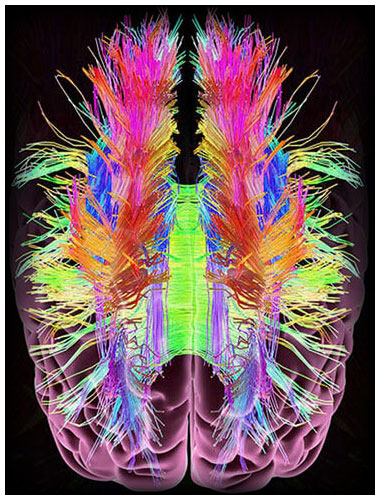
brain scan

Surprisingly, a much more common cause is from a rear-end collision. Most of these brain injuries do not involve obvious trauma like a skull fracture or facial wound. The serious whiplash of the head back and forth due to a violent rear-end collision can cause a life altering brain injury (physicians refer to this injury as a “contrecoup” injury (where the brain contacts the front of the skull and back of the skull due to the whiplash forces).

A contrecoup TBI can injure blood vessels in the brain and cause a slow bleed, which can create pressure that contributes to brain damage and even death. Or the bleeds and tears may be microscopic in nature, but nevertheless have serious consequences on the higher (executive level) functioning of the brain. Contrecoup brain injury involves a contusion remote from, and opposite to, the actual site of impact to the head. A Contrecoup brain injury is an injury mainly prevalent in truck accidents given the large force of a rear-end collision from a commercial truck or tractor-trailer.

These injuries cause the neurons (transmitters) of the brain not to be able to relay the electrical messages of the brain as efficiently or quickly—leading to problems with memory, problem solving, emotion control and impulse control. These injuries can have lasting consequences.
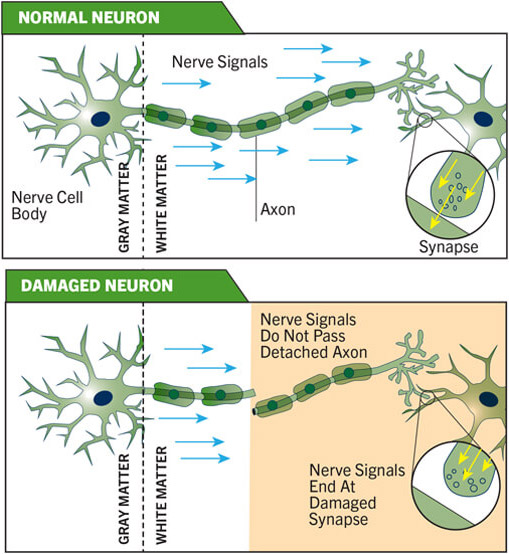
normal neurons

TRAUMATIC BRAIN INJURY SYMPTOMS

Traumatic brain injury often occurs as a result of a severe sports injury, car accident, or 18-Wheeler accident. Immediate or delayed symptoms may include confusion, blurry vision, and concentration difficulty. Infants may cry persistently or be irritable.

Unlike other injuries, the full impact of a traumatic brain injury (TBI) may not be fully known at the time of the accident or even at the time of treatment.

Symptoms may appear days or weeks after an initial diagnosis, and could result in additional − and often expensive − medical treatment. Therefore, if you or a loved one has suffered a head injury due to the negligence of another, you should consult with an experienced personal injury attorney right away to ensure all your expenses − both now and in the future − are protected.

Symptomatic Experiences:
  • Cognitive: amnesia, inability to speak or understand language, mental confusion, difficulty concentrating, difficulty thinking and understanding, inability to create new memories, or inability to recognize common things
  • Behavioral: abnormal laughing and crying, aggression, impulsivity, irritability, lack of restraint, or persistent repetition of words or actions
  • Mood: anger, anxiety, apathy, or loneliness
  • Whole body: blackout, dizziness, fainting, or fatigue
  • Eyes: dilated pupil, raccoon eyes, or unequal pupils
  • Gastrointestinal: nausea or vomiting
  • Speech: difficulty speaking or slurred speech
  • Visual: blurred vision or sensitivity to light
  • Also common: persistent headache, a temporary moment of clarity, balance disorder, bleeding, bone fracture, bruising, depression, loss of smell, nerve injury, post-traumatic seizure, ringing in the ears, sensitivity to sound, or stiff muscles

PHYSICAL SIGNS OF TBI DAMAGE

  • Headache - Dull or sharp pain within the skull. Can occur anywhere with the cranium including areas away from the point of injury
  • Pain around or above the neck - Normally associated with whiplash. The head does not have to be hit for internal damage to occur. The brain tissue is harmed when hitting the inside of a person’s skull
  • Bleeding or bruising to any part of the head - Most obvious sign of minor to severe TBI. This includes nose bleeds, cuts or deep bruising to the face, neck or head
  • Hearing issues - People can lose hearing in one or both ears, hear ringing or high pitched noises that are not present
  • Eyesight problems - Dizziness, Blurred vision, seeing spots or blind spots. People have a hard time focusing or experience changes to vision after knock to head
  • Jaw pain - Normally occur from an act of violence or punch. A blow to the jaw can transfer force to skull resulting in damage to brain
  • Nausea or Vomiting - Similar to motion sickness or seasickness effect. People feel off balance indicating internal damage to the head

MENTAL SIGNS OF TBI DAMAGE

  • Confusion - People are easily confused or disoriented. They can’t remember basic information
  • Changes in mood - Agitation and combativeness levels are higher
  • Mental Status - Days and weeks after an incident a person’s normal behavioral patterns change. Become more aggressive, depressed or anxious
  • Sensitivity to light & sound - Normal sounds and well-lit rooms cause irritation, headache or pain. Suffers of TBI will prefer dark quite rooms

TYPES OF BRAIN INJURIES

When a doctor's mistake (Medical Malpractice) or simple inattention allows a treatable medical condition to result in permanent brain damage, the Traumatic Brain Injury Attorneys at Miller Weisbrod, Attorneys At Law are here to fight for full financial recovery for the victims and their families. Based in Dallas, we serve clients throughout Texas and nationwide.

Head injuries are categorized in three types - Mild, Moderate and Severe. These can have multiple symptoms in common.

Mild Brain Injury
  • Concussion resulting in changes to your mental status
  • Loss of consciousness from 0 to a maximum of 30 minutes
  • Confusion, dizziness, fatigue, memory loss, mood changes and headaches
  • Medical exams and tests (MRI & CAT Scans) may not show damage

Moderate Brain Injury
  • Concussions and Mild symptoms will be present. These issues will last longer and get worse overtime
  • Loss of consciousness from 15 minutes to 5 hours
  • Same symptoms of mild injury but worse
  • Medical exams and brain scans will be used reveal brain tissue damage

Severe Brain Injury
  • Loss of consciousness for more than 5 hours
  • Obvious swelling of head
  • Results in permanent neuro-biological damage
  • Results in a permanent lessening of cognitive abilities and sensory functions
  • Medical exams MRIs & CAT scans will necessary to assess extent of and area of damage
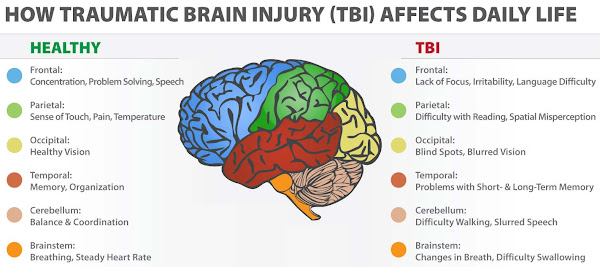
TBI chart

TRAUMATIC BRAIN INJURY TREATMENTS

Treatments for TBIs depend on the severity of symptoms. Treatment may involve rest, medication, or surgery.

MEDICATIONS
Medications include diuretics that help eliminate extra water from the body. It's also prescribed to treat high blood pressure.

SURGERY
Depending on the severity of the injury, a decompressive craniectomy may need to be performed. This is the surgical removal of part of the skull so that an injured brain can swell without being squeezed.

THERAPY
Rehabilitation is the retraining the brain's pathways to improve mental and physical functioning after an illness or injury.

Cognitive behavioral therapy is a talk therapy focused on modifying negative thoughts, behaviors, and emotional responses associated with psychological distress.

Anger management therapy includes practicing mindfulness, coping mechanisms, and trigger avoidance to minimize destructive emotional outbursts.

Counseling psychology is a branch of psychology that treats personal problems related to school, work, family, and social life.

If you notice any of these symptoms, or if you just can’t think clearly after a car accident, then seek medical attention immediately. You should also consult a personal-injury attorney as soon as possible.

CONTACT MILLER WEISBROD

Miller Weisbrod has dozens of million and multimillion dollar verdicts and settlements on behalf of clients who have suffered all levels of TBI. Our demonstrated trial experience and proven record of results are just some of the many reasons clients continue to turn to us in their time of need.

Among other notable cases, Miller Weisbrod recovered $4,250,000 on behalf of a passenger in a truck who suffered a catastrophic brain injury as a result of being forcibly ejected from a truck in a serious motor vehicle accident as well as $1,500,000 for a client injured in a construction/worksite accident after falling from an unstable work platform.

To schedule a free case evaluation regarding your Traumatic Brain Injury (TBI), please contact our office in Dallas at 214.987.0005 or toll free at 888.987.0005. You may also contact us by filling out the form on this page for answers to your questions or to schedule an appointment.

Personal Injury Lawyer Clay Miller

Friday, April 29, 2016

Head-On Collision & Crush Injuries


Head-on collisions are caused when a driver crosses the center dividing line for any reason. The driver could have been trying to pass another vehicle on a two-lane road or could have been driving negligently and moved to the lane of traffic coming from the opposite side. Statistics collected by the Fatal Analysis Reporting System (FARS) brings out the following facts:

• 75 percent of all head-on collisions occur on rural roads.
• Head-on collisions happen most frequently on two-lane roads.
• Of the 7,000 reported head-on collisions on two-lane roads.
  Only 4.2% were caused when a driver was trying to pass another vehicle.
• Failure in negotiating a curve on the road is a cause of 23 percent of fatal head-on collisions.

The FARS data reveals that many head-on collisions result from ‘unintentional maneuvers’ of a driver. These include distracted driving, not following the speed limit, negotiating a curve at a very fast speed, and falling asleep while at the wheel. Driving under the influence is the other major cause of head-on collisions.

In addition to expensive medical bills, a victim of a Head-on collision crush injury may suffer additional financial losses due to the inability to continue working.

A crush injury occurs when two heavy objects compress or squeeze a body part. For example, a passenger’s legs may get squeezed under the dashboard in a head-on collision. A crush injury may damage the muscles, obstruct or completely stop blood flow to an organ, and may even cause tissue death. Some common symptoms of crush injuries include heavy bleeding, bone fractures, bruising, and loss of consciousness.

Crush Injury
Crush injuries are common in head-on car crashes. The vehicles involved in such an accident often are completely damaged, with the seats, steering wheel, dashboard, and other parts getting crushed. In many cases, the passengers inside the car suffer severe injuries. Immediate medical help is required in such situations.

A common injury sustained in a head-on collision is a crushed leg injury. A crushed leg injury occurs when the leg of the victim gets trapped under a heavy object or gets squeezed between two heavy objects. The consequences could be devastating and may even cause loss of the limb. A crushed leg injury may cause lacerations, major fractures, vascular damage, excessive bleeding, and bruising.

Consequences of a Crush Injury
Not all crush injuries are fatal. In case of mild crush injuries, necessary first aid treatment may suffice. However, some crush injuries cause serious medical complications and may even cause death. In addition to severe pain, a victim may develop a serious infection in the injured limb.

There is also the risk of serious bone fractures, and in some cases, the doctor may recommend an immediate surgery. In extreme cases, it may be required to amputate the damaged leg, while some crush injuries may trigger long-term complications, such as chronic pain, neurological and psychological disorders. Another severe outcome of a crush injury could be rhabdomyolysis, a medical condition that causes rapid destruction of skeletal muscles due to extensive muscle damage.

How to Deal with the Consequences of a Crush Injury
Crush injuries require immediate treatment. In most cases, the victim needs to be hospitalized and undergo a surgery. In some cases, long-term treatment will be required. Some symptoms may arise at a later stage and thus the patient needs to watch out for any long-term complications under the guidance of an experienced doctor.

Experience in a Full Range of Personal Injury and Wrongful Death Cases
At Miller Weisbrod, our team of attorneys can offer you the sound advice and concerted legal action you need in order to pursue financial justice and real recover after a serious personal injury or the loss of a loved one. From our office in Dallas, we serve clients nationwide.

We have substantial experience and a proven record of success in obtaining multi-million dollar settlements and verdicts in personal injury cases nationwide.

Motor vehicle accidents include:
• Car accidents
• Truck wrecks
• Motorcycle accidents
• ATV accidents
• Bus crashes
• Boating accidents

Contact Us
To learn more about your rights and legal options in seeking maximum financial recovery after a serious or fatal head-on collision, please call our Dallas office at 214.987.0005 to discuss your rights and legal options with an experienced trial lawyer.

We offer free initial consultations to potential clients nationwide. If you are calling from outside the DFW Metroplex, please use our toll-free line at 888.987.0005.

Monday, February 15, 2016

What are the most common injuries seen in car crashes?


People are injured every day in car, truck and motorcycle accidents. The type and nature of any injury is dependent on the specific facts and dynamics of the crash. Over the years, we have noted most common injuries following a wreck:

Head Trauma: This occurs when the head strikes an object in or outside the vehicle. The head can be traumatized by the roof, windshield, side window, rear window, seats or steering wheel. Trauma to the head can cause a fracture to the bones of the skull or bleeding just under the skull.

Brain Trauma: Injury to the brain can be one of the most devastating injuries to a person after an accident and many times the injured person doesn't realize it until months or years following the crash. The brain is suspended in the skull by fibrous tissue (ligaments) and is bathed in cerebral spinal fluid. (If the victim's head is jerked forward and backwards or hits a stationary object the brain can collide with the inside of the skull causing bruising and damage to nerve cells).

Whiplash: If a car is rear-ended, the quick, forceful impact can cause the occupant's head to jerk backwards and forward. This may cause injury to the soft tissues of the neck (muscles, ligaments, discs). These people can feel neck pain, arm pain, upper back pain and/or headaches.

Spinal Cord Injury: A spinal cord injury may lead to loss of function in the injured person's arms and/or legs depending on the nature extent of damage to the spinal cord. Along with brain injuries, this is one of the most serious types of car accident injuries one may experience.

Upper Extremity Injury: The shoulder, elbow, wrist or hand can be injured in accidents from either direct or indirect trauma. We typically see rotator cuff injuries, fractured forearms and wrist bones because the driver is holding onto the steering wheel or a passenger puts their hands on the dashboard to brace themselves during the crash.

Lower Extremity Injury: A person's hips, knees, ankles or feet can be injured in an accident from blunt force trauma. We typically see knee injuries when peoples' knees are pushed into the dashboard, steering wheel or seat back. We see hip injuries from side impact and front impact collisions and ankle injuries when a person leg is jammed against the brake pedal or foot board.

Internal Injuries: If an accident is forceful, an occupant of the vehicle may experience injury to internal organs. For example, rib fractures can injure the lungs, heart or spleen.

Why Miller Weisbrod?
At Miller Weisbrod, LLP, we focus on results. In our many years of practice, we have developed an in-depth knowledge and familiarity with the structure and design of automobiles and auto parts, which we bring to bear on every case we handle.

We have recovered many million and multimillion dollar verdicts and settlements on behalf of clients who have suffered TBIs. Our demonstrated trial experience and proven record of results are just some of the many reasons clients continue to turn to us in their time of need.

Among other notable cases, Miller Weisbrod recovered $4,250,000 on behalf of a passenger in a truck who suffered a catastrophic brain injury as a result of being forcibly ejected from a truck in a serious motor vehicle accident.

Contact Us
Our attorneys offer sound legal advice, experienced representation and dedicated advocacy to victims of auto accidents and their families. For more information, we invite you to contact our offices in Dallas at 214.987.0005 to schedule a free initial consultation with our experienced personal injury trial lawyers.

If you are calling from outside the DFW Metroplex, please call us toll free at 888.987.0005. You may also contact us by e-mail now for prompt attention or to request an appointment.